
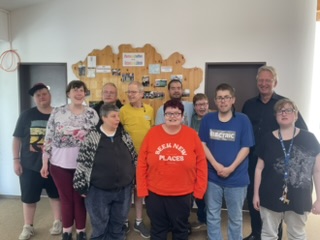
This blog presents the work of a group of adults with PWS in Germany. Through regular discussions on topics such as leisure, relationships, and work, they share their experiences and recommendations for a more inclusive and self-determined life.
We are a group of 12 to 16 participants, women and men, from various parts of Germany. Currently, the participants come from Aachen, Herne, Löhne, Lübbecke, Bad Schwartau, and Steinhagen. We are all adults with PWS, ranging in age from 20 to almost 50.
The group was founded because the International PWS Organisation (IPWSO) suggested that people with PWS should be more involved in the organization’s work and have a greater say in its decisions.
Goals of the group
At its first meeting, the group agreed on the goals it wanted to pursue.
1. The group intends to address the following topics and share the results with other people with PWS and represent them to IPWSO:
- Leisure time
- Relationship and partnership
- Living
- Work
- Equality
- The group aims to develop ways in which people with PWS can be represented in IPWSO, and how they can represent themselves in IPWSO.
Location and frequency of meetings
The group first met on September 29, 2023. Since then, there have been a total of 12 meetings. Between 10 and 14 people attend each meeting. Four meetings are held each year.
The meetings were initially held in Löhne and are now held in Lübbecke (North Rhine-Westphalia), always between 2 pm and 4 pm.
Course of the meetings
Typical course of the day from the perspective of a participant from Herne
“We have lunch at 11:30 am and meet at 12:00 pm in the new building and depart from Herne to Löhne. It takes us 1 hour and 35 minutes by van. The meeting starts at 2 p.m. We discuss topics such as equality, how we want to live and how we want to work, how we want to have a say in IPWSO.
Then there is a break from 3:00 p.m. to 3:15 p.m. Afterwards we work in two small groups or all together. The meeting ends at 4 p.m. and we head back home.”
Previous content and results
Of the topics collected, three topics have been addressed so far:
- Leisure
- Relationships and partnerships.
- Living
The topics are always discussed according to the same pattern:
-
- The changes we would like to see in this area
- Proposed solutions that we have developed for this area.
I. Results on the topic of Leisure
The following leisure activities should be available:
-
- Visit parks or climbing parks.
- A visit to a wildlife park or zoo.
- Holidays in one’s own country or abroad with the support of parents or caregivers.
- Holiday in a leisure center, a youth hostel, or a hotel.
- Day trips with the support of staff, parents or caregivers.
- Sports activities such as horse riding or swimming.
- Holiday opportunities should also be available for couples.
Examples of recommendations and proposed solutions in the area of Leisure
-
- Leisure activities must be adapted to the needs of people with PWS.
- It must be ensured that the staff needed to provide support are paid.
- Training courses should be offered for people with PWS and other disabilities to help them make better use of leisure opportunities. This training can take place, for instance, in a workshop as part of their work-related activities.
- When offering leisure activities or vacation packages, providers must also be informed about the topic of food for people with PWS.
- Leisure activities and holiday offers must be accessible so that many people with PWS can use them.
- The food and drink offerings at cinemas need to be improved; otherwise, it’s too difficult for people with PWS to resist the tempting options. Cinemas and other events should offer a wider range of food and drinks. A list of all available food and drinks should be posted. Information about calories and fat content should always be displayed with the food and drinks. A red, yellow, and green color-coded system, similar to traffic lights, should be used. This would help people with PWS better plan their cinema visit.
- Staff should be available to assist with planning if requested by a person with PWS.
- People with PWS also need to learn to make changes, for example for example in becoming more independent and managing their own food.
- If leisure activities and holiday offers are provided for people with PWS, the organizers must be informed about PWS.
- When hiking, it’s important to choose routes that are suitable for everyone. Both fast and slow walking must be possible.
- It must be ensured that all supervisors at recreational activities can be paid. There are various ways this can be done:
-People with PWS pay for it themselves if they have enough money.
-Parents or relatives pay if they have enough money and if they were involved in the planning.
-Government bodies or other funding organizations should also cover the costs.
-Funding might also be sought from IPWSO.
-The individuals and organizations listed above may fund this either individually or together.
The group discussed how to communicate this recommendation to the various target groups. One example is that the experiences from leisure activities can be reviewed and shared with others who are planning similar activities.
II. Results on the topic of Relationships and Partnerships
Topics covered in this area included: friendship, feeling love, being together, and the desire for children.
- There should be opportunities to meet friends or partners.
- People with PWS can find it difficult to build relationships.
- Shyness can be a challenge, so both partners should have their own space when needed.
- Honesty in a relationship is important.
- Everyone should live the way they want to.
- People should be accepted as they are.
- It is important to coordinate with your partner so that their wishes can be taken into account.
- Partners should not put pressure on one another.
- Being cheated on or having two relationships at the same time can lead to the relationship ending.
- Sometimes people play with each other’s feelings.
- Communication apps can help people express how they feel.
- There should be time to build a relationship.
- It should be possible for women and men to live together, for women to live together, and also for men to live together.
- Relationships between people with PWS should be accepted and respected by others.
- There should be events, such as a singles disco, to help people meet others.
- It should also be possible to attend or even organize dating events.
- Support should be available from staff, parents and relatives when people have questions or problems.
III. Results on the topic of living arrangements
To develop the results presented, the members first collected a list of questions, which they then worked on in small groups.
Questions
1. Who do I want to live with and how many people do I want to live with?
2. What characteristics should the housing offer have?
3. Which rooms would I like to have in the housing offer?
4. Where should the housing be located?
5. What should the surrounding area of the housing offer be like?
6. What kind of support should be offered as part of the housing program?
Results
1. Who do I want to live with and how many people do I want to live with?
- One option is to “live alone.” This could take the form of a single apartment.
- A similar suggestion is living in a single apartment in a building where other people with PWS also live alone in their own apartments.
- The accommodation offered can be a house or an apartment.
- Another option is “living as a couple”, for example in a two-person apartment.
- Living in a shared accomodation is another suggestion. Ideally, each resident should have their own private space within the shared accomodation – “A private living space within shared accommodation”.
- A shared accomodation should not have more than 6 people.
- There should be a sufficient variety of housing options available so that moving is a possibility. Moving can be beneficial if you need more or less support than before. It depends on your individual circumstances.
- The housing options are intended to make it possible to live together with one’s partner.
2. What characteristics should the housing offer have?
- People with PWS should have a say in where they live.
- The housing offer must allow the person with PWS to make decisions about many aspects of it themselves (furnishings, wall color, furniture, etc.).
- Opportunities must be provided for the person with PWS to develop self-confidence in their living situation.
- The accommodation should be as barrier-free as possible. An elevator should be available if the accommodation is above ground level. There should be as few stairs as possible.
- It must be possible to retreat to one’s living space; one must be able to have peace and quiet.
- Since every person with PWS is different, this individuality must be taken into account when choosing housing options.
- The accommodation and surrounding area must allow residents to meet other people without relying on assistance (e.g., transportation services, staff, parents, etc.).
- It is intended that pets can be kept in the accommodation.
3. Which rooms would I like to have in the accommodation offer?
- A bathroom should be available.
- A kitchen should also be available.
- A separate room is necessary; this can also be the bedroom.
- Another requirement was that the accommodation offer should include a living room and a garden.
- A guest room and a guest bathroom are very good, as you can then have guests who stay overnight.
4. Where should the housing be located? (Residential location)
Opinions on this vary greatly.
- It depends on the individual’s preferences.
- These can be housing offers in the city, but also in the countryside.
- It should not be in a city that is too large, nor in a village that is too small.
- It could be a housing offer in Germany, but it could also be a housing offer abroad.
5. What should the surroundings of the housing offer be like?
- The area surrounding the accommodation should offer recreational opportunities so that residents can pursue their hobbies or interests. These opportunities should be accessible on foot or by public transport, so that residents are not dependent on others.
- Sports facilities should be accessible.
- There should be a variety of job offers available so that the person can choose between them.
- Medical services Medical services should be easy to access without relying on others (general practitioner, dentist , etc.).
- Internet and telephone access must be possible.
6. What support services should be offered in the housing program?
- People with PWS should be encouraged and supported to help other people with PWS.
- Support should only be provided for tasks that the person with PWS cannot manage on their own. The presence (assistance) and help of staff must be tailored to what the person with PWS is capable of doing independently . No further assistance should be provided.
- Help can be provided during the day or at night.
- If necessary, it must be possible to lock food so that the person cannot constantly take food (lockable kitchen or pantry, lockable refrigerator, etc.). However, it must also always be possible for everything to be opened again once the person has learned how to handle it.
- The option to use an assistance dog should be available if needed.
There should be the option to use a care service if needed.
Further work and objectives within the group
As part of the annual meeting of the PWS Association Germany eV in Hamburg (2023), the group provided information about its work and goals at a small information stand.
At the International Caregivers Conference in Berlin in May 2024, Christian Blohm gave a presentation in English about the content and goals of our group.
In its November 2024 meeting, the group held an online exchange with representatives of the board and various committees of the IPWSO. The discussion focused on future cooperation with the IPWSO and on joint tasks, with a view to the participation of people with PWS within the IPWSO.
The group is currently contacting other groups of people with PWS worldwide who
are also working to represent the views of people with PWS. We want to exchange information with them about the services and topics they discuss in their groups. We also want to discuss with them how people with PWS can be represented in the future within the national PWS association and the international PWS organization.
We are planning to hold four meetings again in 2027.
Our group in (now) Lübbecke is an open group. Anyone with PWS can participate in our meetings. We are always happy to welcome new members.
You can register for the meeting at nhs@pws-in.de
With kind regards
For the group:
Christian Blohm, Vanessa Lehmann, Arne Scherberich , Andrea Hammer, Pia Bruchhage, Janek Busch, Hendrik Röhrig, Alina Behlert, Katharina Knauff, Tristan Cirksena, Mohamed Jaghou , Melissa Sophie Walther, Yasmin Giesenberg , Jan Quakernack , Norbert Hödebeck-Stuntebeck (Assistant) and others.
Lübbecke, August 20, 2026